The X-ray Universe

I am a user of X-ray observatories and interested in a wide range of science topics accessible via X-rays, especially those described below. More generally, I want to understand how the universe is put together:
- How do the largest structures form?
- When galaxies form, how is their structure and evolution regulated?
- What is dark matter and dark energy?
In my research, I poke into the details of these questions to get a better understanding of the processes behind what makes our universe tick.

|
|
|
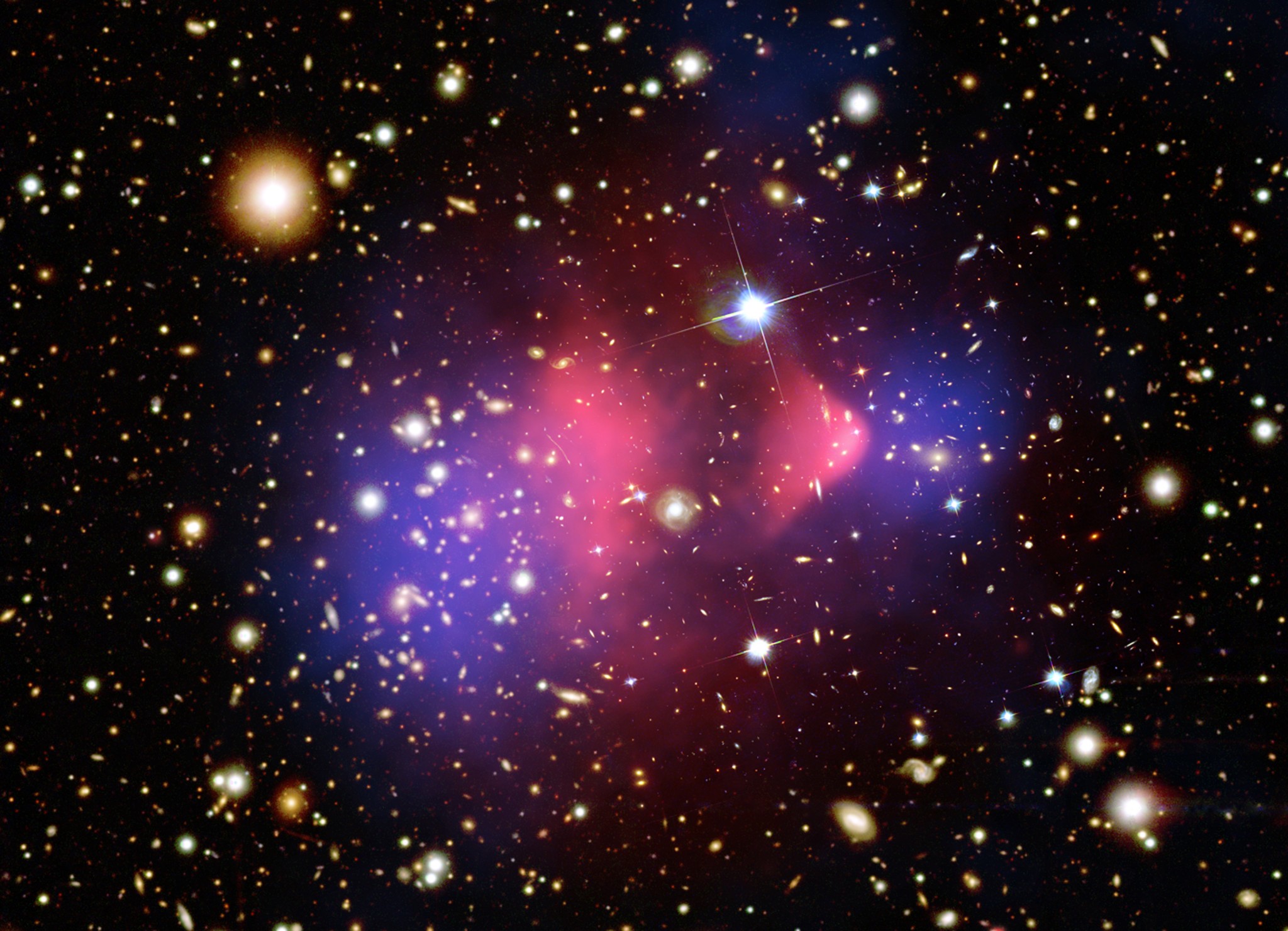
The Bullet Cluster in optical (yellow), X-ray (red), and total mass (blue). This cluster is made up of two clusters undergoing a merger between a massive (left) and a somewhat less massive (right) cluster. Our NuSTAR observations failed to find non-thermal X-rays in this cluster, meaning that there is more non-thermal energy in the gas than previously thought. Also in this cluster, we searched for direct signatures of decaying sterile neutrinos, placing interesting limits on this theoretical flavor of dark matter. |
Galaxy clusters are made up of 100s to 1000s of galaxies, bound by their mutual gravity AND gravity from dark matter and the diffuse gas in between the galaxies. In fact, most of the baryons (normal everyday matter) are in the hot intervening gas, and most of the matter is made up of dark matter. The gas emits X-rays, which better trace the properties of the cluster, such as its mass, history, and dynamical state.
Most of the X-rays we detect are thermal, being emitted by hot gas that is close to equilibrium with the gravitational potential of the cluster. However, in some galaxy clusters that recently formed from two clusters colliding with each other, we see non-thermal radio synchrotron emission, which means there are also non-thermal X-rays in addition to the thermal ones - just fewer of them. Using Suzaku, Swift, and most recently NuSTAR, I've hunted for these elusive photons, which can tell us the strength of the magnetic field in clusters and how much energy is injected into the non-thermal phase of the gas.
During these mergers, huge shocks are driven into the gas, heating it up as the shock wave passes. The exact process by which the gas is heated is unclear, but the temperatures appear to be quite high, requiring a high energy telescope like NuSTAR to accurately measure. Investigations of the shocks in the Bullet cluster data and Abell 665 will help clear up this mystery.

|
|
|
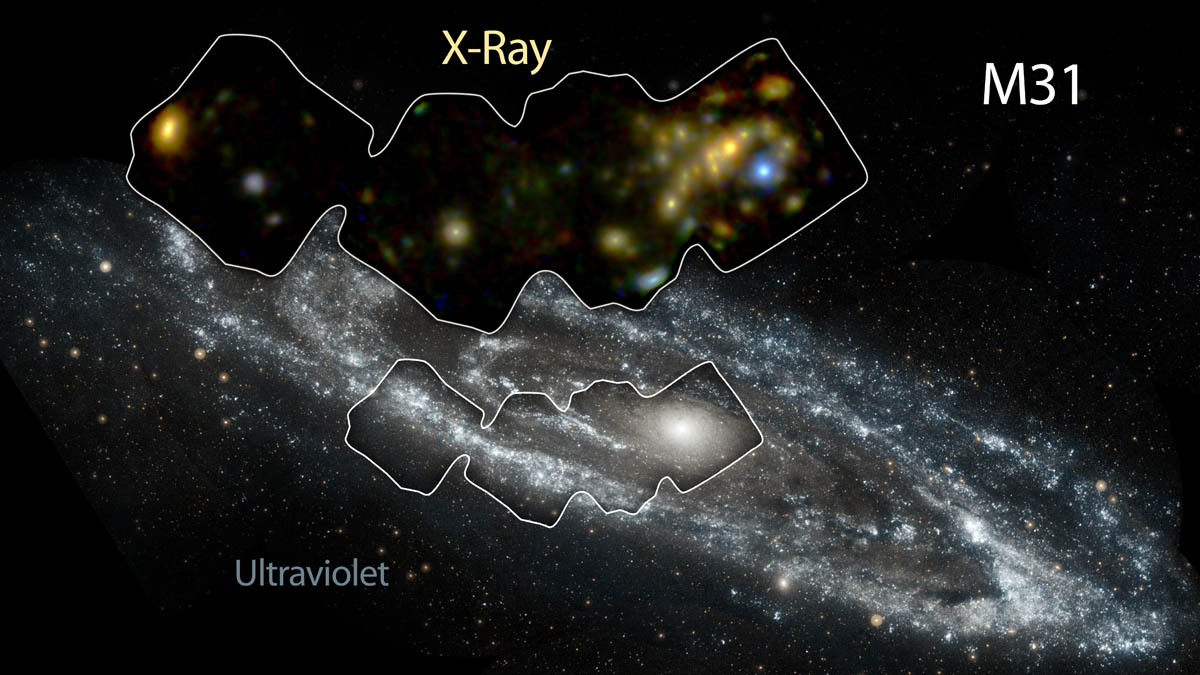
The Andromeda galaxy (M31) in ultraviolet light, mostly showing young, hot stars in spiral arms. NuSTAR mosaicked part of the galaxy (inset), revealing over 100 sources. Their X-ray color indicates the type of dead star - blue/purple for pulsars (a highly magnetized neutron star), blue and red for black holes, and yellow for unmagnetized neutron stars. At high X-ray energies, the entire galaxy is outshined by the bright blue source near the galaxy center, which we believe is a pulsar (paper submitted). |
Most stars are in binary systems, and in some of them - after one of the pair explodes, creating a neutron star or black hole - the newly dead star will feast on the still-burning companion, producing X-rays in the process. This vampiric (or zombie-like? which trope is more popular right now?!?) action can help identify the nature of the feeding beast - at least in our own Galaxy where we can detect the high energy X-rays that are crucial for distinguishing black holes from neutron stars. Unfortunately, it's much harder to do this outside of the Milky Way.
The launch a few years ago of NuSTAR, however, changed all that. NuSTAR is the first focusing X-ray observatory, and its superior sensitivity makes it possible to perform this test in our nearest neighbor, the Andromeda Galaxy (M31), for the first time. The NuSTAR survey of part of M31 is shown in the inset, where the X-ray color strongly hints at the nature of the compact object (i.e., vampire/zombie). It turns out that neutron stars largely dominate the population in M31, contrary to previous claims.
Similar studies in the more distant galaxies NGC 253, M 83, and NGC 3256 and NGC 3310 show that the populations in star-forming galaxies is dominated by "ultraluminous X-ray sources," or ULXs, which may be intermediate mass black holes (although recent NuSTAR discoveries may suggest that many of them are in fact pulsars!).

|

|
|
Cosmic backgrounds as a function of wavelength (Cooray 2016). Relic radiation from the Big Bang produces the CMB; star formation dominates the optical and infrared emission; and the growth of supermassive black holes through accretion is traced by the cosmic X-ray background. |
The universe, on average, produces radiation at all wavelengths, which we call cosmic background radiation. At different wavelengths or energies, the emission is produced by different objects: the relic radiation of the big bang produces the microwave background, galaxies create the optical and infrared backgrounds, and supermassive black holes at the centers of galaxies, also called active galactic nuclei or AGN, produces the X-ray background. AGN emit this light while consuming surrounding gas - exactly like black holes and neutron stars that form from dying stars. However, AGN grow to be millions to billions of times more massive than dead stellar cores, growing over the entire age of the universe by ripping passing stars apart and accreting their stripped gas.
|
|
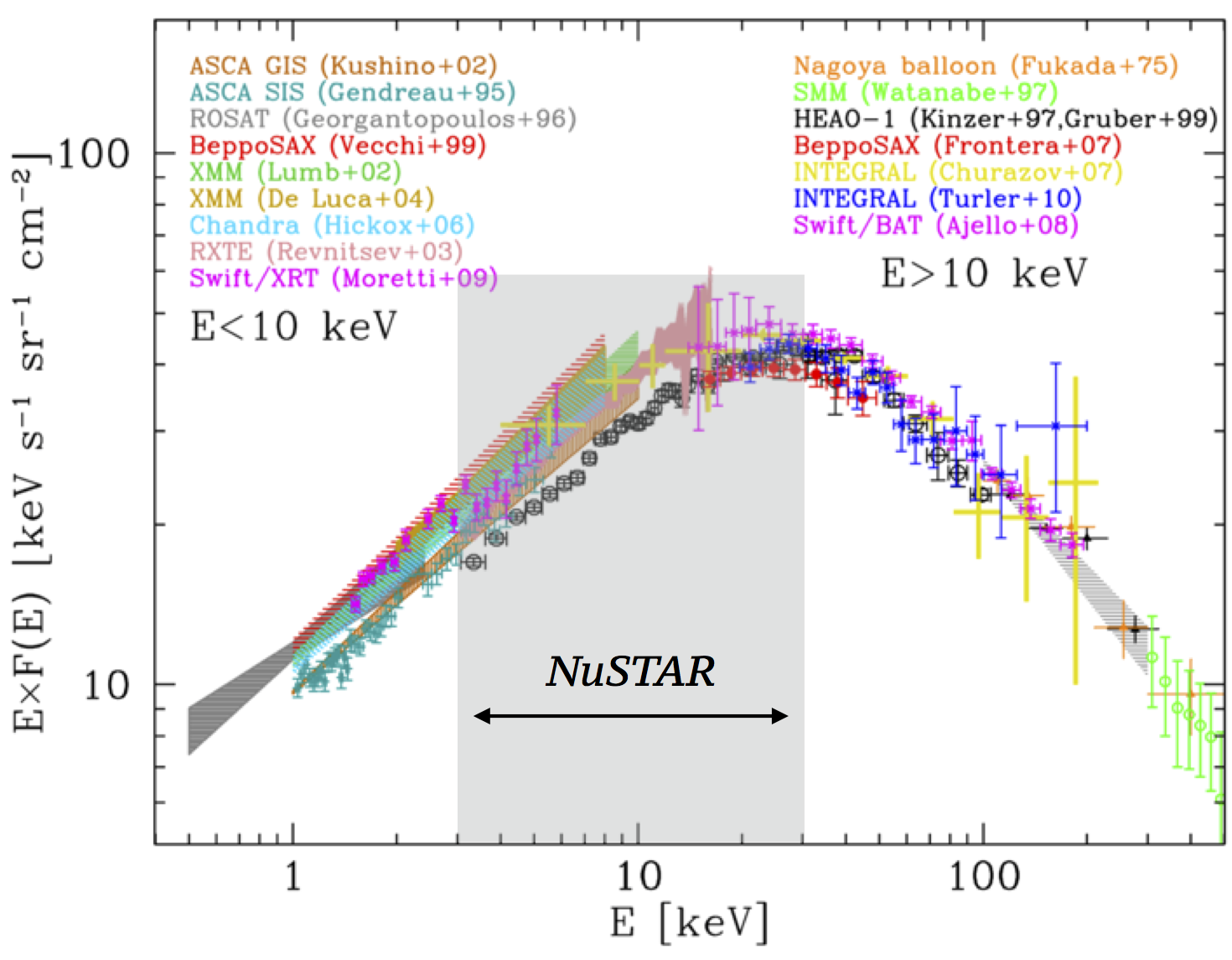
Measurements of the cosmic X-ray background by various missions (Gilli 2013). Offsets between measurements, particularly large below 10 keV but still significant at the 10% level above 10 keV, preclude a precise census of the AGN populations producing this emission. |
Since the birth of X-ray astronomy over 40 years ago, observatories have measured the cosmic X-ray background as a function of energy, but many of those measurements are in mild disagreement. It turns out to be notoriously difficult to absolutely calibrate these telescopes, which is largely due to the lack of a "standard candle" in the X-ray sky - an object whose brightness never changes - and the challenge of characterizing a telescope that undergoes the stresses of a rocket launch and then operates in microgravity without humans being able to tinker or even look at it again after launch. The amount of radiation in the X-ray background is important because it contains the entire history of accretion onto supermassive black holes, and differences of 10% in the normalization or shape of the background spectrum can translate into vastly different evolutionary histories of the growth of AGN.
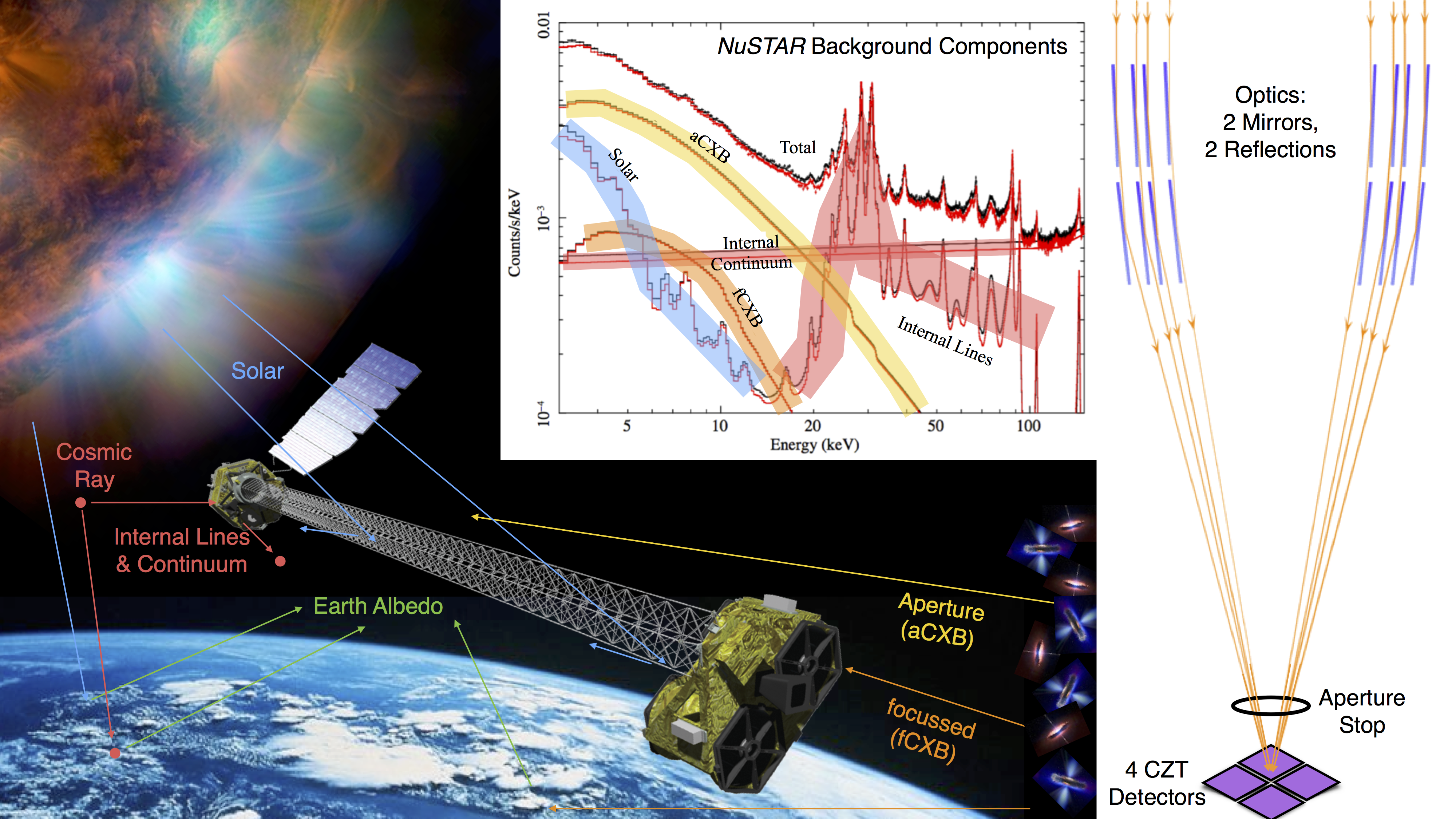
Through a quirk of design, the NuSTAR Observatory - sensitive at exactly the energies where these discrepancies are greatest - routinely detects the cosmic X-ray background as "stray light" shining directly on the detectors. Once a careful study is made of the path this light takes through the telescope and of the other sources of background (see below), the entire archive of NuSTAR observations can be brought to bear on the question of precisely how bright and what color the X-ray background is, and what that implies about the types of AGN in the universe.
|
|
The NuSTAR Observatory consists of two telescopes side-by-side, each focussing X-rays through an aperture stop into a focal plane covered by 4 CdZnTe detectors (Right Panel). In the Left Panel, NuSTAR (pointing to the right) is illustrated with the cause of each major background component and its contribution to the background spectrum (inset). At the softest energies, scattered emission from the Sun (Solar) is significant, and at the hardest energies, cosmic ray-induced radioactivity and fluorescence produce both internal lines and a continuum (Instrumental). The cosmic X-ray background (represented by cartoon AGN) is both focused by the optics (fCXB) and shines on the detectors through the aperture stops (aCXB). The Earth Albedo spectrum is likely present at some level in Earth-occulted observations, but is not present otherwise. |

|

|
|
The preliminary STAR-X logo, based in part on my original design (still like mine better). |
At the end of 2016, NASA is accepting proposals for new astronomy missions called Explorers; this call is for a MidEx-sized mission ($250M). I'm involved in one such mission, the Survey and Time-domain Astrophysical Research eXplorer, or STAR-X. It's a soft X-ray observatory with a 1 square degree field of view, large collecting area, and fast slewing capability. If selected, it would fly ~2023 and look for electromagnetic counterparts of gravitational wave sources, catch stars being devoured by supermassive black holes, conduct deep and large area surveys of AGN and galaxies, and observe the outermost parts of nearby massive galaxy clusters AND clusters in the distant universe as they're forming.
|
|
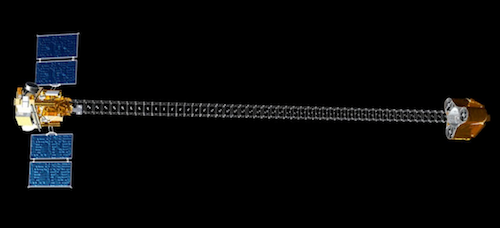
A mock up of HEX-P, which looks eerily similar to NuSTAR, largely because it is a suped-up version of that fabulous observatory. |
Every decade, the astronomy community puts together a plan for the next 10 years, a process called the Decadal Survey. As part of that survey, I'm also involved in a "Probe-class" ($500M-$1B) mission concept, the High Energy X-ray Probe, or HEX-P. Basically, it would be a better version of NuSTAR, with more collecting area and finer angular resolution, which would be a fantastic advance.